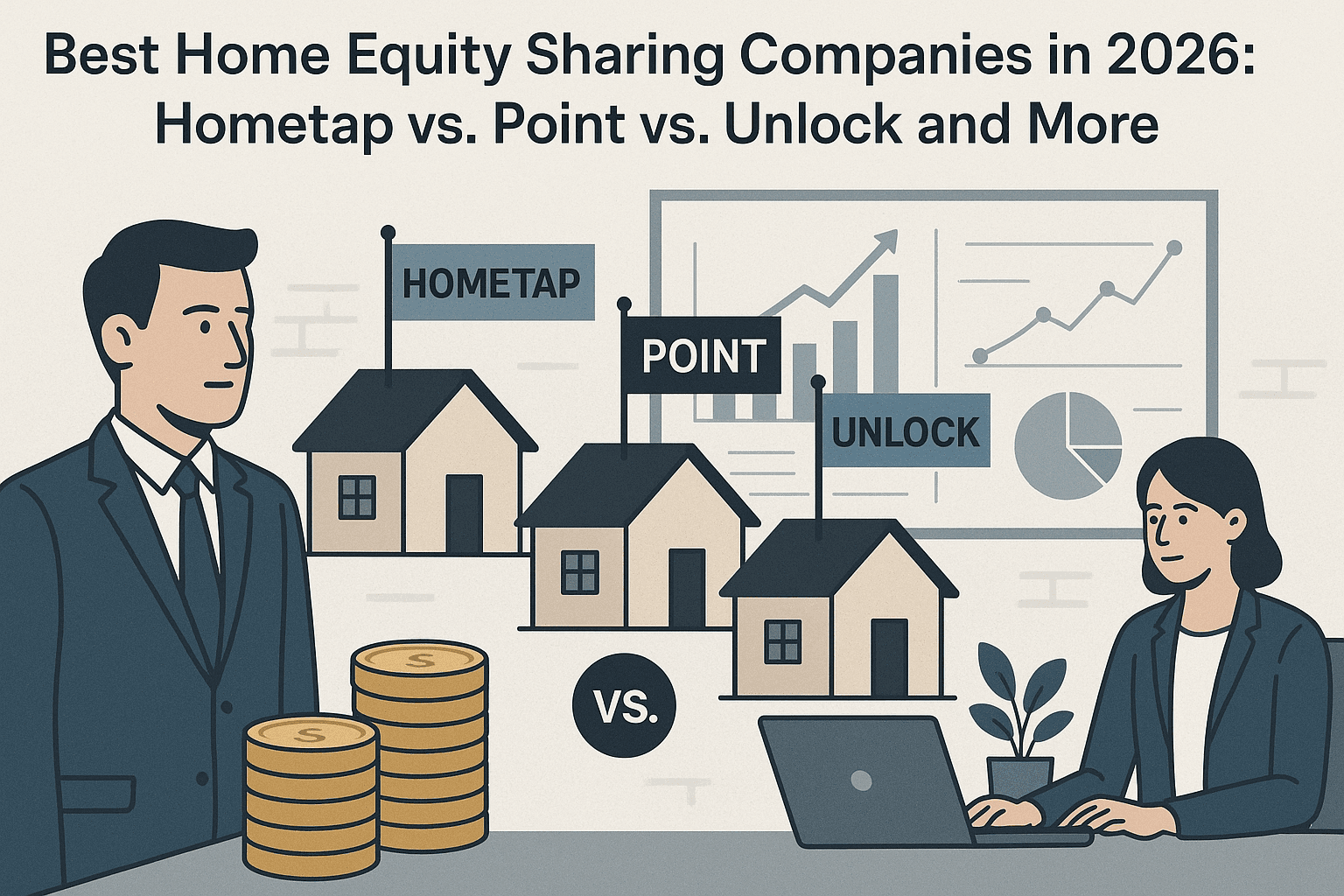
If you''re comparing the best home equity sharing companies in 2026, Hometap, Point, and Unlock lead the market — Hometap for a straightforward investment with no monthly payments, Point for flexible terms and lower credit requirements, and Unlock for the ability to make partial buybacks over time. A home equity investment (HEI) gives you cash today in exchange for a share of your home''s future value, with no monthly payment. We ranked six providers on terms, costs, eligibility, and flexibility. This guide helps you decide if an HEI fits before you apply.
How We Ranked These Companies
| Criteria | Weight | Why It Matters |
|---|---|---|
| Cost and equity share | High | The percentage of future value you give up drives total cost |
| Eligibility requirements | High | Credit, equity, and state availability determine access |
| Term length and flexibility | Medium | Longer terms and buyback options reduce pressure |
| Transparency | Medium | Clear fees and terms protect homeowners |
Data sources: provider disclosures and home-equity-investment industry resources. Last updated: June 2026. HEIs are complex — read every contract carefully.
1. Hometap — Simple, No-Monthly-Payment Investment
Best for: Homeowners who want cash now without monthly payments.
Hometap provides a lump sum in exchange for a share of your home''s future value, typically over a 10-year term with no monthly payments. You settle by selling, refinancing, or buying out the investment.
Pros
- No monthly payments or interest
- Funding without adding debt to your balance sheet
Cons
- You give up a share of appreciation
- Must settle within the term (often ~10 years)
Who This Is Best For
Equity-rich homeowners who want cash without a new monthly bill. Not ideal if you expect rapid home appreciation you''d rather keep.
2. Point — Flexible Terms and Lower Credit Bar
Best for: Homeowners with lower credit scores. Point offers longer terms and tends to accept lower credit profiles than some competitors.
Pros
- More lenient credit requirements
- Longer available terms
Cons
- Shares future appreciation
- Fees and discounts to value can be significant
Who This Is Best For
Homeowners with substantial equity but imperfect credit.
3. Unlock — Partial Buybacks Over Time
Best for: Homeowners who want to settle gradually. Unlock allows partial buybacks, so you can reduce the company''s stake before the term ends.
Pros
- Partial buyback flexibility
- Considers a range of credit profiles
Cons
- Appreciation share still applies
- State availability is limited
Who This Is Best For
Homeowners who want to chip away at the investment over time.
4. Unison — Long 30-Year Term
Best for: Homeowners wanting maximum time. Unison offers notably long terms, reducing pressure to settle quickly.
Pros
- Very long term reduces near-term pressure
- No monthly payments
Cons
- Long exposure to shared appreciation
- Higher equity requirements
Who This Is Best For
Homeowners planning to stay long-term who want breathing room.
5. Splitero — Homeowner-Friendly Positioning
Best for: Homeowners in served states wanting a consumer-focused option. Splitero emphasizes transparency and homeowner outcomes.
Pros
- Consumer-focused approach
- Competitive terms in served markets
Cons
- Limited state availability
- Newer relative to larger players
Who This Is Best For
Homeowners in eligible states seeking a transparent provider.
6. A HELOC or Home Equity Loan (The Alternative)
Best for: Homeowners who can handle monthly payments. A traditional HELOC or home equity loan lets you keep all your appreciation in exchange for paying interest.
Pros
- You keep 100% of future appreciation
- Often lower total cost if you repay reasonably quickly
Cons
- Requires monthly payments and good credit/income
- Adds debt and foreclosure risk
Who This Is Best For
Homeowners with steady income and good credit who''d rather pay interest than share appreciation.
Quick Comparison
| Company | Monthly Payment | Typical Term | Standout Feature |
|---|---|---|---|
| Hometap | None | ~10 years | Simplicity |
| Point | None | Up to ~30 years | Lower credit bar |
| Unlock | None | ~10 years | Partial buybacks |
| Unison | None | Up to 30 years | Longest term |
| Splitero | None | Varies | Consumer focus |
| HELOC/loan | Yes | Varies | Keep your appreciation |
How We Researched This
We compared provider disclosures on equity share, term length, eligibility, fees, and state availability, and included traditional HELOC/loans as the key alternative. We emphasize that HEIs trade future appreciation for no monthly payment — a tradeoff that''s costly in a rising market. Last updated: June 2026. We review this guide quarterly.
Frequently Asked Questions
What is a home equity investment (HEI)?
It''s a cash lump sum today in exchange for a percentage of your home''s future value, with no monthly payments. You settle by selling, refinancing, or buying it out.
Is a home equity investment better than a HELOC?
It depends. An HEI has no monthly payment but costs you appreciation; a HELOC keeps your appreciation but requires payments. Compare total cost for your timeline.
What credit score do I need?
Requirements vary; Point and Unlock tend to accept lower scores than some competitors. Equity matters more than credit for many HEIs.
How much can I get?
Typically a percentage of your equity, capped by the provider and your home''s value. Each company sets its own limits.
What happens if my home value rises a lot?
You share that appreciation with the company, which can make an HEI expensive in a hot market.
Are there monthly payments?
No — that''s the main appeal. You settle the full amount at the end of the term or when you sell or refinance.
Can I buy out the investment early?
Often yes, sometimes with partial buybacks (Unlock). Confirm buyout terms before signing.
What are the risks?
Giving up significant appreciation, settlement pressure at term end, and complex contracts. Read everything and consider professional advice.
Important Disclosures
This content is for informational purposes only and does not constitute financial advice. Home equity investments are complex financial products; terms, costs, eligibility, and state availability change frequently and vary by provider. Review all contracts carefully and consult a licensed financial or legal advisor before proceeding.
