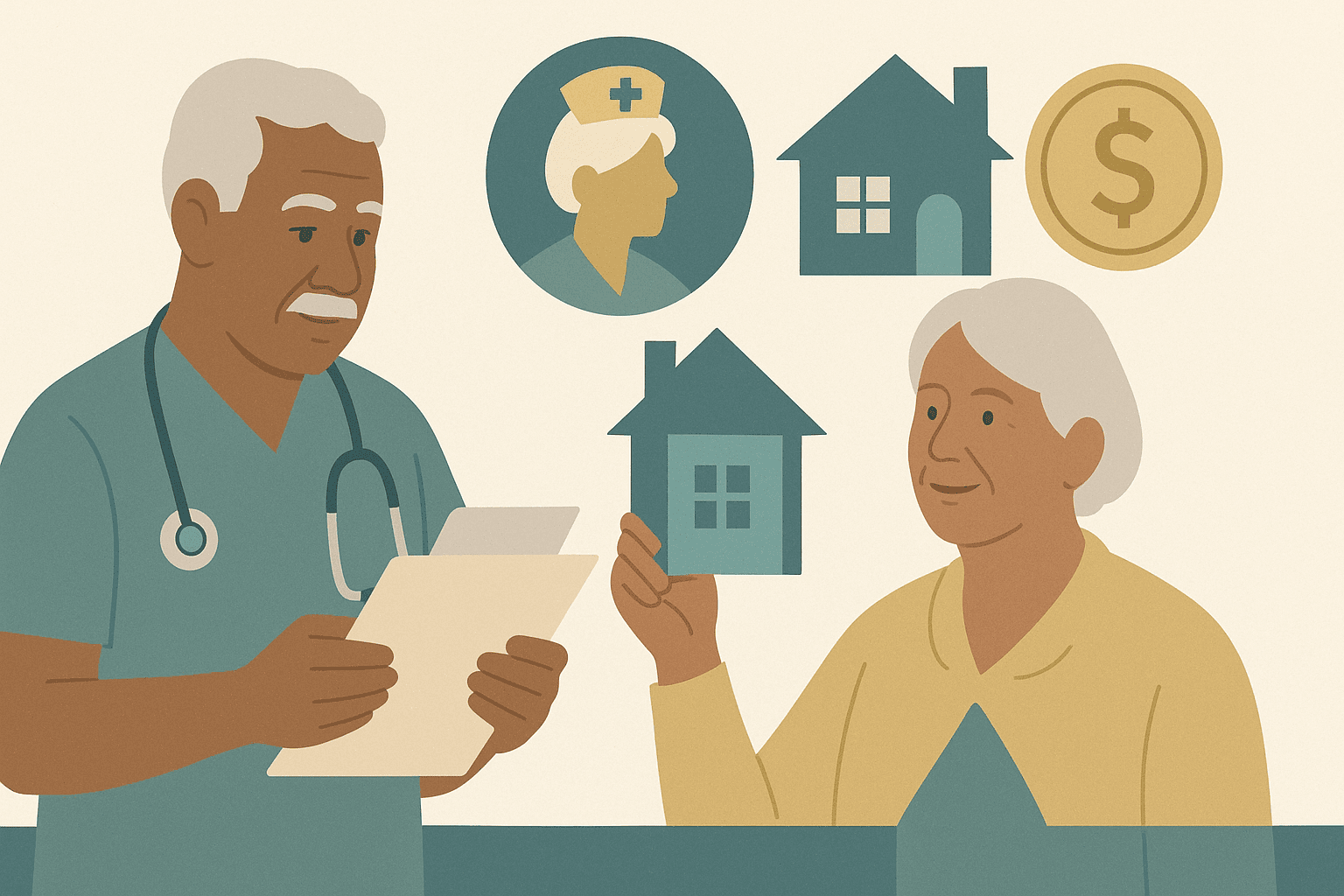
If you are a nurse shopping for a mortgage in 2026, the two programs that fit the most nurses are the conventional 3% down options (Conventional 97, HomeReady, and Home Possible) and, for nurses who served in the military (learn more about best first-time homebuyer programs of 2026: federal, state & lender programs ranked) (learn more about what is groundfloor? mortgage lender overview | rateroots) (learn more about what is civic? mortgage lender overview | rateroots) (learn more about usda loan requirements), the VA loan at 0% down with no monthly mortgage insurance. We ranked seven loan programs and program types on down payment, mortgage insurance cost, credit flexibility, how broadly they cover nursing roles, and total cost over five years.
Here is the part most "nurse mortgage" pages leave out: there is no single mortgage product reserved for nurses (learn more about how to improve business credit score?) (learn more about what is readycapital? business lender overview | rateroots). The best program depends on your down payment, credit score, military service history, and where the home is located — not on whether a lender puts the word nurse on the landing page. This guide ranks the underlying programs so you can shop the loan, not the badge.
How We Ranked These Programs
We evaluated each program across five criteria:
| Criteria | Weight | Why It Matters |
|---|---|---|
| Down payment required | High | Cash to close is the single biggest barrier for nurses buying their first home, especially new grads carrying student debt. |
| Mortgage insurance cost | High | Mortgage insurance can add hundreds per month and, on some programs, never falls off — it often outweighs a small rate difference. |
| Credit flexibility | Medium | Minimum score guidelines determine who can qualify at all, and lender overlays can sit above the agency floor. |
| Eligibility breadth for nursing roles | Medium | Some programs cover every borrower equally; others (physician loans) cover only certain clinical titles. |
| Total cost over five years | High | Nurses relocate and change employers often. Five-year cost — payment plus mortgage insurance plus upfront fees — reflects real ownership horizons better than rate alone. |
Data sources: HUD Handbook 4000.1 (FHA), the VA Lender Handbook (VA Pamphlet 26-7), USDA Rural Development guaranteed loan guidance and eligibility maps, Fannie Mae and Freddie Mac Selling Guides, the Consumer Financial Protection Bureau, and individual state Housing Finance Agency program pages.
A note on rates: we do not publish rates or APRs in this guide. Mortgage pricing moves daily and varies by lender, credit score, loan size, occupancy, and state. Any page quoting a fixed "nurse rate" is quoting a snapshot, not an offer. Compare live quotes from at least three lenders on the same day.
1. Conventional 97 / HomeReady / Home Possible — Low down payment with mortgage insurance that ends
Best for: Nurses with a 620+ credit score who want a small down payment without permanent mortgage insurance
Typical down payment: 3%
Mortgage insurance: Private mortgage insurance (PMI), cancellable
These three conventional programs let qualified buyers put down as little as 3%. The structural advantage over FHA is that private mortgage insurance is not permanent: under the Homeowners Protection Act, borrowers can request cancellation at 80% loan-to-value and the servicer must automatically terminate it at 78% LTV on the original amortization schedule. HomeReady (Fannie Mae) and Home Possible (Freddie Mac) add income-qualified benefits, including reduced mortgage insurance coverage requirements.
Pros
- PMI ends, which removes a recurring cost FHA borrowers often carry for the life of the loan
- HomeReady and Home Possible allow reduced MI coverage for income-eligible borrowers
- No property location restriction and no service history requirement
- Works for the largest share of nurses of any program on this list
Cons
- Generally requires a 620 minimum credit score, and pricing gets meaningfully worse below roughly 680
- HomeReady and Home Possible carry area median income caps, which can exclude higher-earning CRNAs and experienced nurses in some markets
- PMI on a 3% down loan at a lower credit score can be expensive in the early years
- Loan amount is capped at the conforming limit for your county
Who This Is Best For
This is the default starting point for most nurses with decent credit and a modest down payment. If your income is under the local AMI threshold, ask specifically about HomeReady or Home Possible rather than a standard Conventional 97 — the reduced MI coverage is a real cost difference. It is a weaker fit if your credit is under 620 or if you need the higher debt-to-income tolerance FHA sometimes allows.
2. VA Loan — Zero down and no monthly mortgage insurance, if you served
Best for: Nurses who are veterans, active-duty service members, National Guard or Reserve members, or eligible surviving spouses
Typical down payment: 0%
Mortgage insurance: None (a one-time VA funding fee applies to most borrowers)
For nurses with qualifying military service, the VA loan is difficult to beat on structure: no down payment on most purchases and no monthly mortgage insurance at all. In place of MI, the VA charges a one-time funding fee that can be financed into the loan and that varies by down payment and first-versus-subsequent use. Borrowers receiving VA compensation for a service-connected disability are generally exempt from the funding fee.
Pros
- 0% down with no monthly mortgage insurance is the lowest recurring structural cost on this list
- Funding fee is often waived for borrowers with a service-connected disability rating
- More flexible underwriting on residual income and credit history than most conventional programs
- The benefit is reusable — entitlement can be restored after a prior VA loan is paid off
Cons
- Eligibility is service-based only; a nursing degree, a hospital job, or working at a VA medical center does not qualify you
- The funding fee can be significant when it applies, particularly on a repeat use with no down payment
- The property must meet VA Minimum Property Requirements, which can complicate offers on fixer-uppers
- Primary residence only — it will not finance an investment property
Who This Is Best For
Any nurse with a Certificate of Eligibility should price a VA loan first and compare it against everything else. It is the wrong tool if you have no service history, if you are buying a second home or rental, or if the property you want will not pass VA appraisal condition standards.
3. State Housing Finance Agency (HFA) Programs and Down Payment Assistance — The biggest cash-to-close lever
Best for: Nurses who can afford the monthly payment but are short on cash for down payment and closing costs
Typical down payment: 0% to 3% of your own funds, with assistance covering the rest
Mortgage insurance: Varies by the underlying loan (usually FHA or conventional)
Every state runs a Housing Finance Agency, and many counties and cities run their own programs. These typically pair a first mortgage with down payment assistance delivered as a grant, a forgivable second lien, or a deferred second. Some states run assistance tiers specifically for healthcare workers, teachers, and first responders. This is usually the single largest reduction in cash needed at closing available to a nurse.
Pros
- Can eliminate most or all of the down payment and closing-cost hurdle
- Some states carve out healthcare-worker or essential-worker priority tiers
- Assistance is frequently forgivable after a set occupancy period
- Stacks on top of FHA, conventional, VA, or USDA first mortgages
Cons
- Income limits, purchase price caps, and first-time buyer requirements are common
- Funding is finite and programs periodically pause when allocations run out
- The first mortgage rate is sometimes above market, so the assistance can be partly offset by a higher payment
- Homebuyer education is often mandatory, and only a subset of lenders are approved to originate the program
Who This Is Best For
Nurses who qualify on income and debt ratios but have not accumulated a down payment. Check your own state HFA site before you shop lenders, because the program dictates which lenders you can use. It is a weaker fit for higher-income nurses above the income caps, or for anyone who may sell or refinance before the assistance forgiveness period ends.
4. FHA Loan — The credit flexibility option
Best for: Nurses with credit scores in the 580 to 660 range or a higher debt-to-income ratio
Typical down payment: 3.5% at 580+ FICO (10% at 500 to 579)
Mortgage insurance: Upfront MIP plus annual MIP, often for the life of the loan
FHA exists to make homeownership reachable for borrowers who do not clear conventional credit standards. HUD Handbook 4000.1 sets the minimum down payment at 3.5% for borrowers at 580 or above, and 10% between 500 and 579. The trade is mortgage insurance: an upfront premium financed into the loan plus an annual premium that, when the down payment is under 10%, generally stays for the full loan term rather than falling off at 78% LTV.
Pros
- The most forgiving credit standards of any widely available program
- Higher debt-to-income tolerance with compensating factors, which matters for nurses carrying student loans
- Gift funds for the entire down payment are permitted from an eligible source
- Pricing is far less credit-score-sensitive than conventional, so lower-score borrowers are penalized less on rate
Cons
- Annual mortgage insurance typically does not cancel when the down payment is under 10% — refinancing out is the usual exit
- Upfront MIP increases your loan balance from day one
- FHA appraisal standards can complicate competitive offers in tight markets
- County loan limits are lower than conforming limits in many areas
Who This Is Best For
Nurses whose credit is still recovering, or new grads with heavy student debt pushing debt-to-income beyond conventional tolerance. If your score is comfortably above 680 and you have 3% to put down, run the conventional numbers side by side first — the cancellable PMI often wins over a five-year horizon.
5. Physician and Professional Loans Extended to Advanced Practice Nurses — Powerful, but narrow
Best for: Nurse practitioners, CRNAs, and in some cases physician assistants at lenders that explicitly include those titles
Typical down payment: 0% to 10%
Mortgage insurance: Usually none
Physician loan programs (sometimes marketed as professional or doctor loans) offer low or no down payment with no mortgage insurance and often a more favorable treatment of student loan debt in the debt-to-income calculation. The critical caveat: eligibility is defined by the individual lender, not by a government agency. Many programs cover only MD, DO, DDS, and DMD. Some extend to NPs, CRNAs, and PAs. Comparatively few include staff RNs.
Pros
- No mortgage insurance even at very low down payments, which can beat FHA and low-down conventional on monthly cost
- Deferred or income-driven student loan payments are often treated more favorably in debt-to-income
- Some programs allow an employment contract with a future start date to be used as qualifying income
- Higher loan amounts than conforming limits are common, which helps in expensive metros
Cons
- Eligibility for RNs is limited and varies sharply by lender — you must confirm your exact credential is on the approved list
- These are portfolio loans, so pricing and terms are lender-specific and not standardized
- Very low equity at the start means a move within a few years can leave you underwater after selling costs
- The rate is sometimes higher than a comparable conventional loan, offsetting part of the MI savings
Who This Is Best For
Advanced practice nurses with strong income, high student debt, and little saved cash. Ask the lender directly, in writing, whether your title qualifies before you pay for an appraisal. If you are a staff RN, assume you are not eligible until a specific lender confirms otherwise, and do not let a physician-loan pitch keep you from pricing a conventional loan.
6. USDA Guaranteed Rural Housing Loan — Zero down for rural hospital markets
Best for: Nurses working at rural or small-town hospitals and clinics who meet income limits
Typical down payment: 0%
Mortgage insurance: An upfront guarantee fee plus a smaller annual fee (lower than FHA annual MIP)
USDA is the quietest 0% down program in the country, and it maps unusually well to nursing because rural hospitals and critical access facilities sit inside eligible areas. Two gates apply: the property must be in a USDA-eligible area, and household income must fall under the county limit. Both are checked on USDA Rural Development eligibility maps and income tables, not estimated. The annual fee is generally lower than FHA annual MIP, which makes the recurring cost competitive.
Pros
- 0% down without any military service requirement
- Annual fee is typically lower than FHA annual mortgage insurance
- Eligible areas include many suburban fringe communities, not just remote farmland
- No separate first-time buyer requirement
Cons
- Household income limits count the income of household members who are not on the loan
- Geographic eligibility is strict and maps are periodically redrawn
- Primary residence only, and property condition standards apply
- Processing can involve an additional agency review step, which can extend timelines
Who This Is Best For
Nurses at rural and small-town facilities who are within the income cap. Check the address on the USDA eligibility map before anything else — the map answer is binary and settles whether this program is even on the table. It is a poor fit for dual-income households in higher-cost counties, where the income limit is often the binding constraint.
7. Employer Housing Assistance and Hero-Branded Discount Programs — Real, but usually small
Best for: Nurses employed by large health systems or universities, and buyers using agent and lender fee-rebate networks
Typical down payment: Varies (this is a supplement, not a loan)
Mortgage insurance: Determined by the underlying loan
Some hospital systems, universities, and municipalities offer employer-assisted housing: forgivable loans, closing-cost grants, or relocation assistance, often tied to buying within a defined radius of the campus. Separately, "hero" branded networks offer rebates on real estate agent commission and reductions on lender or title fees. Both are supplements layered on top of one of the six programs above.
Pros
- Employer assistance is frequently forgivable and can be genuine free money toward closing
- Fee rebates and agent commission credits reduce cash needed at closing
- Stacks with any first mortgage program, including HFA assistance in many cases
- Some employer programs are not income-restricted
Cons
- Employer programs often require you to stay employed for a set period or repay the benefit
- Hero-branded rebates typically reduce fees, not your interest rate, and the dollar amounts are modest
- Rebate networks route you to a specific agent or lender, which can cost more than the rebate saves
- Availability is inconsistent and often unadvertised — you have to ask HR directly
Who This Is Best For
Every nurse should ask their HR or benefits office whether employer-assisted housing exists before closing, because it costs nothing to check. Treat hero-branded rebates as a tiebreaker only, and never as a reason to skip shopping the loan itself.
Quick Comparison
| Program | Down Payment | Min Credit Guideline | Mortgage Insurance | Occupancy / Location Limits | Best For |
|---|---|---|---|---|---|
| Conventional 97 / HomeReady / Home Possible | 3% | ~620 | PMI, cancels at 80% LTV | Primary residence for 3% down; income caps on HomeReady/Home Possible | Most nurses with 620+ credit |
| VA | 0% | No agency minimum (lender overlays apply) | None; one-time funding fee | Primary residence only | Nurse veterans and service members |
| State HFA + DPA | 0-3% own funds | Varies by program | Follows underlying loan | Income and price caps; often first-time buyer | Nurses short on cash to close |
| FHA | 3.5% at 580+ | 580 (500 with 10% down) | Upfront + annual MIP, often for loan life | Primary residence only | Credit-challenged or high DTI |
| Physician / Professional | 0-10% | Typically 700+ | Usually none | Primary residence; lender-defined titles | NPs and CRNAs at participating lenders |
| USDA Guaranteed | 0% | ~640 typical lender guideline | Upfront guarantee + annual fee | Eligible rural area; income caps | Rural hospital and clinic nurses |
| Employer / Hero programs | N/A (supplement) | N/A | Follows underlying loan | Often a radius from employer | Anyone layering assistance |
What To Watch For In Nurse-Branded Offers
A "nurse home loan" is almost always one of the six programs above with nurse-specific marketing on top. That is not inherently bad — some lenders genuinely understand shift differential and travel contract income better than a generalist. But the badge itself does not lower your cost, and treating it as proof of a better deal is how nurses overpay.
Three things to check on every nurse-branded offer:
Compare Loan Estimates, not marketing. Federal rules require lenders to issue a standardized Loan Estimate. Get one from at least three lenders on the same day, and compare page 2 origination charges and page 3 total five-year cost side by side. Same-day matters — pricing moves, and a stale quote is not a comparison.
Watch for a rate buy-down paid for with higher fees. A lower advertised rate is often purchased with discount points or elevated origination charges buried in section A. If a nurse program shows a better rate but a materially higher cash-to-close, you may simply be prepaying for the discount. Run the breakeven: divide the extra upfront cost by the monthly savings, and compare that number of months against how long you actually expect to stay.
Confirm the underlying program. Ask directly: is this an FHA loan, a conventional loan, a VA loan, or a portfolio product? That answer determines your mortgage insurance structure, your cancellation rights, and your loan limit — all of which matter more over five years than any branded discount.
How We Researched This
This guide is built from program-level source documents rather than lender marketing: HUD Handbook 4000.1 for FHA down payment and mortgage insurance rules, VA Pamphlet 26-7 and VA program guidance for entitlement and funding fee structure, USDA Rural Development guaranteed loan guidance and the public eligibility maps for area and income tests, and the Fannie Mae and Freddie Mac Selling Guides for Conventional 97, HomeReady, and Home Possible parameters. Consumer-protection framing on Loan Estimates and comparison shopping follows Consumer Financial Protection Bureau guidance. State program structure is drawn from state Housing Finance Agency program pages, which vary by state and change without notice.
We deliberately excluded lender-specific rankings and any current rate or APR figures. Mortgage pricing changes daily and is specific to your credit profile, loan size, and location, so a published rate would be inaccurate before most readers saw it. We also excluded programs that require paid membership to access.
Last updated: August 21, 2026. We review this guide quarterly and after material agency guideline changes.
Frequently Asked Questions
Do nurses get special mortgage rates?
No. There is no federally sanctioned rate discount for nurses. Some lenders market nurse programs with a fee credit or a modest pricing adjustment, but these are lender promotions, not a distinct loan type. Your rate is driven by credit score, down payment, loan size, occupancy, and daily market pricing.
Can travel nurses qualify for a mortgage with contract income?
Yes, but documentation is stricter. Travel and contract income is generally treated as variable income, so lenders typically want a two-year history of receiving it, tax returns, and evidence the work is likely to continue. Gaps between assignments are averaged into the income calculation, which can lower your qualifying figure. Some lenders handle travel nurse files routinely and others do not — ask before applying.
Does per-diem, overtime, or shift differential income count?
Usually yes, if it has a track record. Fannie Mae and Freddie Mac guidelines generally require a documented history of variable income, commonly two years, and the lender averages it rather than using your best month. Shift differential and overtime that has been consistent typically counts; a recent bump after a schedule change may not. Bring pay stubs showing year-to-date detail and two years of W-2s.
Can a new grad nurse with student debt qualify for a home loan?
Often, yes. Lenders count a student loan payment in your debt-to-income ratio even when the loan is deferred or in an income-driven plan at zero dollars, using a percentage of the outstanding balance as a substitute payment. The exact percentage differs by program, which is why the same borrower can pass on one program and fail on another. A new grad with a signed offer letter can sometimes use future employment income if the start date is near.
What credit score do I need to buy a house as a nurse?
Roughly 580 for FHA with 3.5% down, and about 620 for conventional 3% down programs. VA sets no agency minimum, but individual lenders impose their own overlays, often around 620. Higher scores meaningfully reduce both your rate and your private mortgage insurance premium on conventional loans.
Do nurse practitioners qualify for physician loans?
Sometimes. Physician loan eligibility is defined by each lender, and many programs include NPs, CRNAs, and PAs while others limit the product to MD, DO, DDS, and DMD. Staff RNs are included far less often. Confirm your specific credential with the lender in writing before you commit to the process.
Is FHA or conventional better for a nurse?
It depends on your credit score. Below roughly 660, FHA is usually cheaper because its pricing is less sensitive to credit. Above roughly 680 with 3% or more down, conventional often wins over five years because private mortgage insurance cancels at 80% loan-to-value while FHA annual MIP typically does not. Have a loan officer run both scenarios with a five-year cost comparison.
Can I use down payment assistance with a nurse loan program?
Frequently yes, but not always. Most state Housing Finance Agency assistance pairs with FHA, VA, USDA, or conventional first mortgages through approved lenders only. A lender-specific nurse promotion or a portfolio physician loan may not be eligible to combine with HFA assistance. Confirm compatibility before you apply.
Do I have to be a first-time buyer to use these programs?
Not for FHA, VA, USDA, or standard conventional loans. The 3% down Conventional 97 has a first-time buyer requirement in its standard form, and many state HFA and down payment assistance programs also restrict to first-time buyers, though several states waive that in targeted areas or for certain occupations.
How many lenders should a nurse get quotes from?
At least three, all on the same day. CFPB research has consistently found that comparison shopping produces meaningfully better terms, and same-day quotes are the only way to compare fairly since pricing moves daily. Multiple mortgage inquiries within a standard shopping window are treated as a single inquiry by common credit scoring models.
Important Disclosures
This content is for informational and educational purposes only and does not constitute financial, mortgage, tax, or legal advice. RateRoots is not a lender and does not originate loans. Loan program guidelines, rates, fees, mortgage insurance costs, income limits, and eligibility requirements change frequently and vary by state, county, lender, and borrower profile. Program details described here reflect general agency guidance as of the last updated date and should be verified with the issuing agency and a licensed loan officer before you rely on them. Nothing here is a commitment to lend or an offer of credit. Consult a licensed mortgage professional and, where appropriate, a tax advisor about your specific situation.
We support equal housing opportunity. All lenders referenced or implied are expected to comply with the Fair Housing Act and the Equal Credit Opportunity Act, which prohibit discrimination in residential lending. Some links on this page may be affiliate links. This does not influence our rankings — our methodology is described above.
