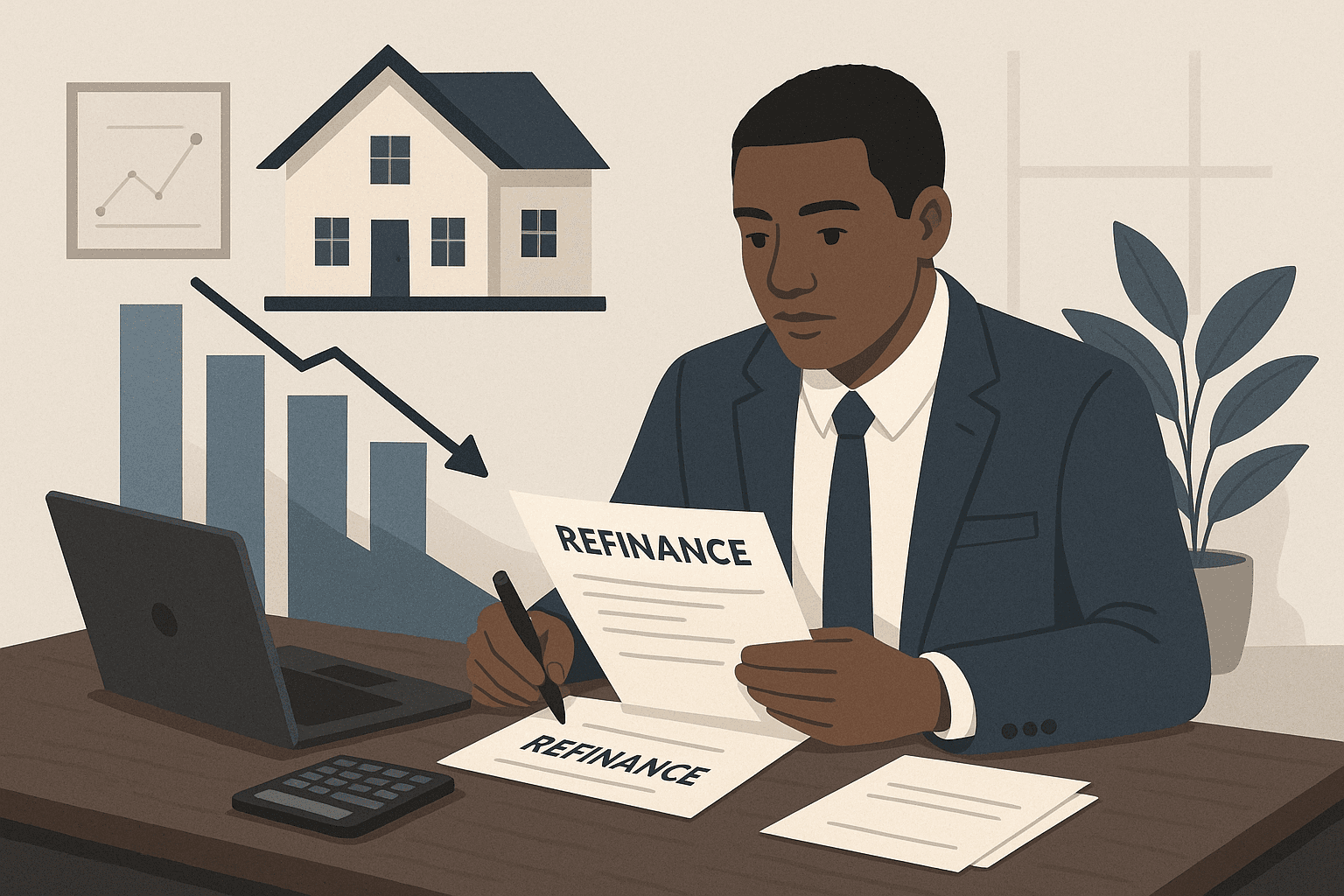
Refinancing an Underwater Mortgage: A Strategic Guide to Regaining Your Equity
Refinancing an underwater mortgage—where you owe more than your home is worth—is not a simple rate-and-term transaction, learn more about what is private mortgage fund? mortgage lender overview | rateroots, learn more about what is archway fund? mortgage lender overview | rateroots, learn more about what is lendterra? mortgage lender overview | rateroots, learn more about can i get a mortgage with 500 credit score?. It is a strategic financial maneuver to escape negative equity, often requiring specialized government programs like HARP’s successors, learn more about can i get a mortgage with 600 credit score? or a cash-in refinance. The core challenge isn't just credit score or income; it's convincing a lender to issue a new loan for a property that lacks sufficient collateral value. Success hinges on understanding the specific, limited pathways available, the exact lender requirements for each, and a clear assessment of whether the long-term financial benefit justifies the upfront cost and effort. This guide will walk you through the reality of your options, the detailed eligibility checkpoints, and the strategic philosophy needed to navigate one of the most complex scenarios in home finance.
Consider this: the concept of being “underwater” on a mortgage was a niche financial term for most of the 20th century. Lending was conservative, down payments were substantial, and widespread home price declines were rare. The 2008 financial crisis changed that lexicon forever, as plummeting values left millions of homeowners with negative equity. In response, the government and lending industry created temporary, emergency measures. Today, while the crisis-era Home Affordable Refinance Program (HARP) is gone, its philosophical offspring and other specific options remain for those still caught in its wake or facing new localized downturns. Refinancing underwater isn't about chasing the lowest rate; it's about structural financial repair.
The Underwater Reality: More Than Just a Number
Being underwater, or having negative equity, is first a psychological weight and then a mathematical problem. It means your largest asset is also your largest liability, trapping you in place. You cannot sell without bringing a check to the closing table, and you cannot access equity you may have once had. But crucially, not all “underwater” situations are alike, and the depth matters.
A homeowner who is 5% underwater ($380,000 owed on a $400,000 home that’s now worth $380,000) is in a vastly different position from one who is 40% underwater ($400,000 owed on a home now worth $240,000). The first may be a candidate for a standard refinance with a slight adjustment, while the second is in the realm of loan modification or strategic default. The Loan-to-Value (LTV) ratio is the king metric here. Standard refinances typically cap at 80-97% LTV, depending on the program. Once you cross 100% LTV, you leave the world of conventional financing and enter a specialized arena with stricter gates.
Moreover, you must identify why you’re underwater. Is it due to a broad market correction in your city? Did you purchase at the peak of a cycle with minimal down payment? Or was it a combination of deferred maintenance and localized decline? The reason won’t change your LTV, but it will inform your strategy and set realistic expectations for recovery. A home in a fundamentally strong market that dipped temporarily presents a different long-term outlook than one in an area with persistent economic challenges.
Your Navigational Chart: The Available Pathways
When your mortgage is underwater, the map of standard refinance options vanishes. In its place are a few narrow, well-defined trails. Choosing the right one depends entirely on who owns your loan, the type of loan you have, and your exact financial posture.
The High-LTV Refinance for Government-Backed Loans (FHA, VA, USDA)
This is often the most viable path. The Federal Housing Administration (FHA), Department of Veterans Affairs (VA), and USDA have specific streamline refinance programs that do not require a new appraisal or have very liberal LTV limits.
- FHA Streamline Refinance: The standout feature here is the lack of a credit underwriting package or appraisal in most cases. The lender uses your original purchase price or last appraised value. To qualify, you must have an existing FHA loan, be current on your payments (with no more than one 30-day late payment in the last 12 months), and demonstrate a "Net Tangible Benefit." This benefit is usually defined as lowering your monthly principal and interest payment by at least 5% or switching from an adjustable-rate to a fixed-rate mortgage. Crucially, your unpaid balance can even increase slightly to cover closing costs (a "roll-in"), which is a rare allowance.
- VA Interest Rate Reduction Refinance Loan (IRRRL): Often called a "VA Streamline," this program is famously flexible. There is no appraisal, no maximum LTV, and no requirement to certify your income or credit again. You must have an existing VA loan and use the new loan to pay off the old one. The core requirement is that the new payment must be lower than the old one for the same term, excluding taxes and insurance. Like the FHA version, you can roll most costs into the loan, even if it pushes you further underwater temporarily.
- USDA Streamline Assist: For existing USDA Section 502 Direct or Guaranteed loans, this program also waives the need for an appraisal, credit review, or debt-to-income (DTI) verification. The focus is solely on payment history—you must have made the last 12 payments on time.
The Cash-In Refinance: The Strategic Reset
If your loan is not government-backed or you don’t qualify for a streamline, the "cash-in" refinance is your most powerful, self-directed tool. The concept is simple: you bring cash to the closing table to pay down your principal balance, thereby creating instant equity to reach a loan-to-value ratio that a conventional lender will accept (typically 97% or lower for the best terms).
This is not for the faint of heart. It requires significant liquid savings. However, it’s a calculated investment in your financial architecture. You are using cash to buy a lower interest rate and a stable mortgage, effectively transferring wealth from a savings account (earning minimal interest) to your mortgage (where it saves you interest at a higher rate). The break-even analysis is critical here: how many months of lower payments will it take to recoup the cash you injected? If you plan to stay in the home well beyond that point, it can be a brilliant strategic move.
Loan Modification: Changing the Terms of Your Existing Loan
Refinancing replaces your old loan with a new one. A modification changes the terms of your existing loan with your current servicer. This is a viable path if you are struggling to make payments or are at risk of default. Modifications can reduce the interest rate, extend the loan term (e.g., from 30 to 40 years), or even, in rare cases, forgive a portion of the principal (a "principal reduction"). Programs like the government's Home Affordable Modification Program (HAMP) have expired, but many lenders have proprietary in-house modification programs. The process is often lengthy and requires demonstrating financial hardship, but it can be a lifeline that avoids refinancing altogether. It does not, however, typically result in a rate as low as a market refinance.
The Closed Door: What’s No Longer Available
It’s vital to understand what you’re not eligible for to avoid wasted effort. The Home Affordable Refinance Program (HARP), which allowed refinances up to 125-150% LTV on Fannie Mae and Freddie Mac loans, expired in December 2018. Some successor "high-LTV" programs exist from the agencies, but they are far more restrictive than HARP was, often requiring you to be barely underwater. True, deep-negative-equity refinancing for conventional loans without a cash infusion largely died with HARP.
The Eligibility Gauntlet: Proving You’re a Worthwhile Exception
Qualifying for any of these specialized programs is a steeper climb. Lenders are taking on a loan with inadequate collateral, so they mitigate risk by scrutinizing everything else.
Payment History: Your Single Most Important Document
Your payment history is no longer just a factor; it is the foundation. For streamline programs, it is often the primary factor. Lenders need to see that, despite the lack of equity, you have honored your debt obligation impeccably. A single 30-day late payment in the last 6-12 months can disqualify you from most streamline refinances. You are asking for an exception based on proven reliability.
Credit Score: The Higher, The Better
While some streamline programs may not pull a full credit report, your score still matters for pricing. For a cash-in refinance or any standard underwriting, you will need a strong credit score—often 680 or higher, with 720+ to access the best rates. The lender needs to be confident in your financial behavior when the collateral itself is insufficient.
Debt-to-Income Ratio: Proving Manageability
Your DTI ratio—the percentage of your gross monthly income that goes toward debt payments—must be solid. Typically, you’ll need to be at 43% or lower, and some programs may require an even stronger ratio, like 41%. This proves that even with the new mortgage payment, your finances are not stretched to the breaking point.
The "Net Tangible Benefit" Test
This is the regulatory and common-sense heart of a refinance. You must prove the new loan leaves you in a demonstrably better position. For government streamline programs, this is a formal rule. For others, it’s an underwriting principle. The benefit can be:
- A reduction in your interest rate and monthly payment.
- Moving from a risky adjustable-rate mortgage (ARM) to a stable fixed-rate loan.
- Shortening your loan term to build equity faster.
- Removing mortgage insurance (though this is rare with high LTV).
You and your lender must be able to articulate this benefit clearly. Refinancing just to extend your term and lower your payment slightly while increasing total interest paid over time may not pass this sniff test for a savvy underwriter.
The Step-by-Step Process: A Realistic Timeline
Gather Your Intelligence: Start with your most recent mortgage statement. Note your servicer, loan type (FHA, VA, Conventional), interest rate, and balance. Then, get a realistic sense of your home’s current value. Don’t rely on Zillow’s Zestimate alone. Look at recent sales of comparable homes in your neighborhood from the last 3-6 months, or pay for a broker’s price opinion (BPO) for a few hundred dollars. This will give you your true LTV.
Audit Your Financials: Pull your credit report (AnnualCreditReport.com) and score. Calculate your DTI ratio: total monthly debt payments (existing mortgage, car loans, student loans, minimum credit card payments) divided by your gross monthly income. Scrutinize your bank statements for the last 12 months to ensure no missed mortgage payments.
Identify Your Pathway: Based on your loan type and LTV, determine which option from the list above is your target. If you have an FHA loan and are current, the FHA Streamline is your first call. If you have a conventional loan and 10% in cash, the cash-in refinance is your project.
Shop Lenders with Specificity: You are not shopping for a generic refinance. Call lenders and lead with your scenario: “I’m looking to do an FHA Streamline Refinance on a loan that’s potentially underwater. Do you have experience with these?” You want a loan officer who doesn’t hesitate and understands the specific paperwork and guidelines. Compare the rates and closing costs they offer for your specific program.
Submit a Bulletproof Application: When you apply, provide everything requested immediately and cleanly. For a streamline, this is often just proof of income, a mortgage statement, and proof of homeowners insurance. For a cash-in refinance, be prepared with full documentation: two years of tax returns, two months of bank statements, pay stubs, and documentation for the source of your cash-in funds (to meet anti-money laundering rules).
Underwriting and Closing: The underwriter will verify everything and ensure the loan meets the specific program guidelines. For streamline programs, this can be quick—sometimes under 30 days. For cash-in refinances, it follows a standard 30-45 day timeline. At closing, you’ll sign the new loan documents and, if applicable, provide a certified check for the cash-in amount.
The Strategic Decision: When Refinancing Isn’t the Answer
The hard truth is that refinancing an underwater mortgage is not always the optimal financial move. You must run the numbers with cold objectivity.
If you are deeply underwater (say, 125% LTV or more) and have an already low interest rate (e.g., a 3.5% FHA loan), a streamline refinance might only lower your rate by 0.5%. The monthly savings could be minimal, and the closing costs—even if rolled in—add to your debt. The "net tangible benefit" may be too small to justify the hassle.
In such a scenario, the better strategy might be strategic patience. Continue making your payments on time. As you pay down the principal and (hopefully) the market recovers, your LTV will slowly improve. You can then revisit a refinance when you reach 95-97% LTV, potentially to remove mortgage insurance or get a better rate. Alternatively, investing extra cash in home improvements that boost value can be a more targeted way to build equity than a cash-in refi.
For some, a short sale or deed-in-lieu of foreclosure, while damaging to credit, can be a less destructive escape hatch from an unsustainable debt burden on a severely depreciated asset. This is a last-resort option that requires legal and tax advice.
Conclusion: Navigating to Solid Ground
Refinancing an underwater mortgage is a testament to responsible financial management in a difficult situation. It is the opposite of walking away. It requires you to confront the numbers, understand a complex landscape, and often, to demonstrate fiscal discipline when your asset has failed you.
The path is narrow and specific, governed by loan type, payment history, and program rules. Success lies not in hoping for a generic solution but in meticulously matching your unique situation to the precise program designed for it—be it the appraisal-free relief of an FHA Streamline, the veteran’s benefit of a VA IRRRL, or the assertive reset of a cash-in refinance.
By approaching this not as a simple rate chase but as a strategic project of financial repair, you can transform a position of negative equity into one of stability and eventual recovery. You are not just changing your loan; you are charting a deliberate course back to solid ground.
Disclaimer: This article is for informational and educational purposes only. It does not constitute personalized financial, legal, or tax advice. Mortgage rates, terms, and program availability vary by lender and are subject to change based on market conditions and borrower qualifications. Eligibility for any refinance program depends on specific lender underwriting criteria. Always consult with a qualified mortgage professional, financial advisor, or HUD-approved housing counselor to discuss your individual circumstances before making any financial decisions.
Mortgage Refinance Library
- How to Refinance a Mortgage: The Complete Step-by-Step Guide (2026)
- How to Refinance with Bad Credit?
- 7 Best Mortgage Refinance Lenders of 2026: Ranked by Rate, Fees, and Approval Speed
- Best Cash-Out Refinance Lenders 2026: Rates, LTV Limits & Requirements Compared
- Best FHA Streamline Refinance Lenders of 2026: 7 Options Compared
- Best Rate-and-Term Refinance Lenders of 2026: Top 7 Compared
- Can I Refinance with Negative Equity?
- Cash-Out Refinance vs. HELOC in 2026: 7 Factors That Decide Which One Wins
- Refinance vs Home Equity Loan
- What Is a Cash-Out Refinance and How Does It Work?
