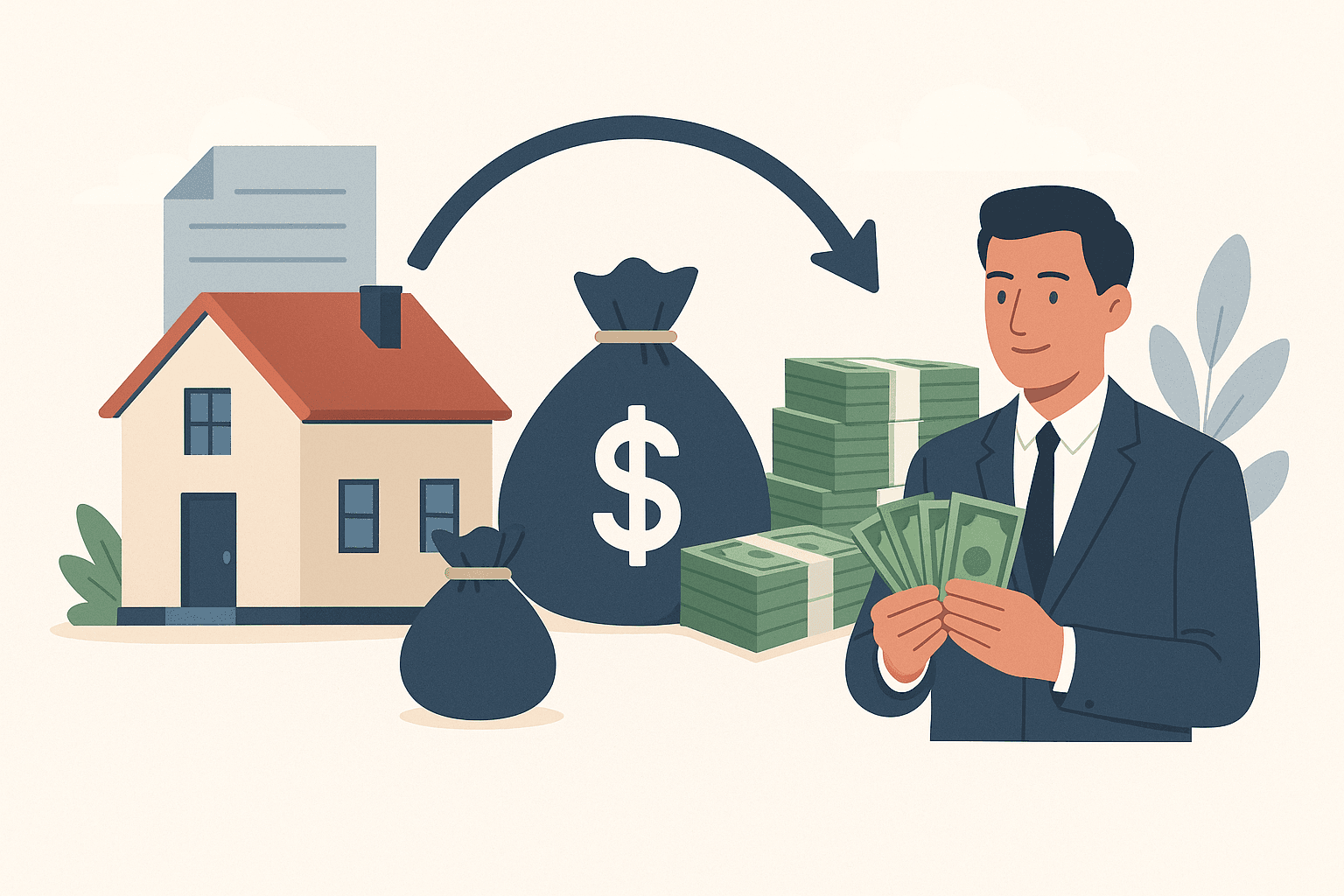
If you have built up equity in your home, a cash-out refinance is one of the most common ways to turn that equity into usable cash. Here's exactly how it works, what it costs, and when it makes sense.
How a cash-out refinance works
Say your home is worth $400,000 and you owe $220,000. You have $180,000 in equity. With a cash-out refinance, you might take out a new loan for $300,000, use $220,000 to pay off the old mortgage, and pocket the remaining $80,000 (minus closing costs) in cash. You now have one new mortgage of $300,000.
Most lenders let you borrow up to about 80% of your home's value on a conventional cash-out refinance, so you generally need to keep at least 20% equity in the home. The cash you receive is a loan, not income, so it isn't taxed — but you do pay interest on it as part of your new mortgage.
Cash-out refinance requirements
Lenders typically look for:
- Equity: Enough to borrow against while leaving roughly 20% in the home (loan-to-value of about 80% or less for conventional loans).
- Credit score: Often 620 or higher for conventional loans, with the best rates going to higher scores.
- Debt-to-income ratio: Generally 43% or lower, though this varies.
- Income and employment: Documentation proving you can repay the new, larger loan.
- An appraisal: To confirm your home's current market value.
Government-backed options like FHA and VA cash-out refinances have their own rules and may allow higher loan-to-value limits.
What it costs
A cash-out refinance has closing costs similar to your original mortgage — typically 2% to 5% of the loan amount, covering the appraisal, origination, title, and other fees. Because you're borrowing more, your monthly payment may rise, and you may pay a slightly higher interest rate than a standard rate-and-term refinance.
Cash-out refinance vs. HELOC vs. home equity loan
| Option | Structure | Best for |
|---|---|---|
| Cash-out refinance | Replaces your mortgage with a larger one | Tapping a large lump sum, possibly improving your rate |
| Home equity loan | Second loan on top of your mortgage | A fixed lump sum without touching your first mortgage |
| HELOC | Revolving line of credit on your equity | Flexible, ongoing access to funds |
If current rates are near or below your existing mortgage rate, a cash-out refinance can be attractive. If your current rate is much lower than today's rates, a home equity loan or HELOC may let you tap equity without giving up that low first-mortgage rate.
When a cash-out refinance makes sense
It's often a smart move for value-adding home improvements, consolidating high-interest debt into a lower mortgage rate, or funding a major planned expense. It's riskier when used for everyday spending or depreciating purchases, because you're converting unsecured flexibility into debt secured by your home — if you can't pay, the home is on the line.
Frequently asked questions
How much cash can I get from a cash-out refinance? Typically up to 80% of your home's value minus what you still owe, for a conventional loan. On a $400,000 home where you owe $220,000, that's roughly up to $100,000 before closing costs.
Do you pay taxes on cash from a refinance? No. The cash is loan proceeds, not income, so it isn't taxed. Mortgage interest may be deductible if the funds are used to buy, build, or substantially improve the home — confirm with a tax professional.
Does a cash-out refinance hurt your credit? There's a small temporary dip from the credit inquiry and the new account, but responsibly managing the new mortgage — and paying off high-interest debt with the cash — can help your credit over time.
A cash-out refinance can be a powerful way to put your home equity to work, but it resets your mortgage and uses your home as collateral. Compare it against a HELOC or home equity loan, run the closing costs and new payment, and make sure the use of funds justifies borrowing against your home.
This article is for general informational purposes only and is not financial or lending advice. Loan terms, rates, and requirements vary by lender and situation; consult a licensed mortgage professional before making a decision.
